

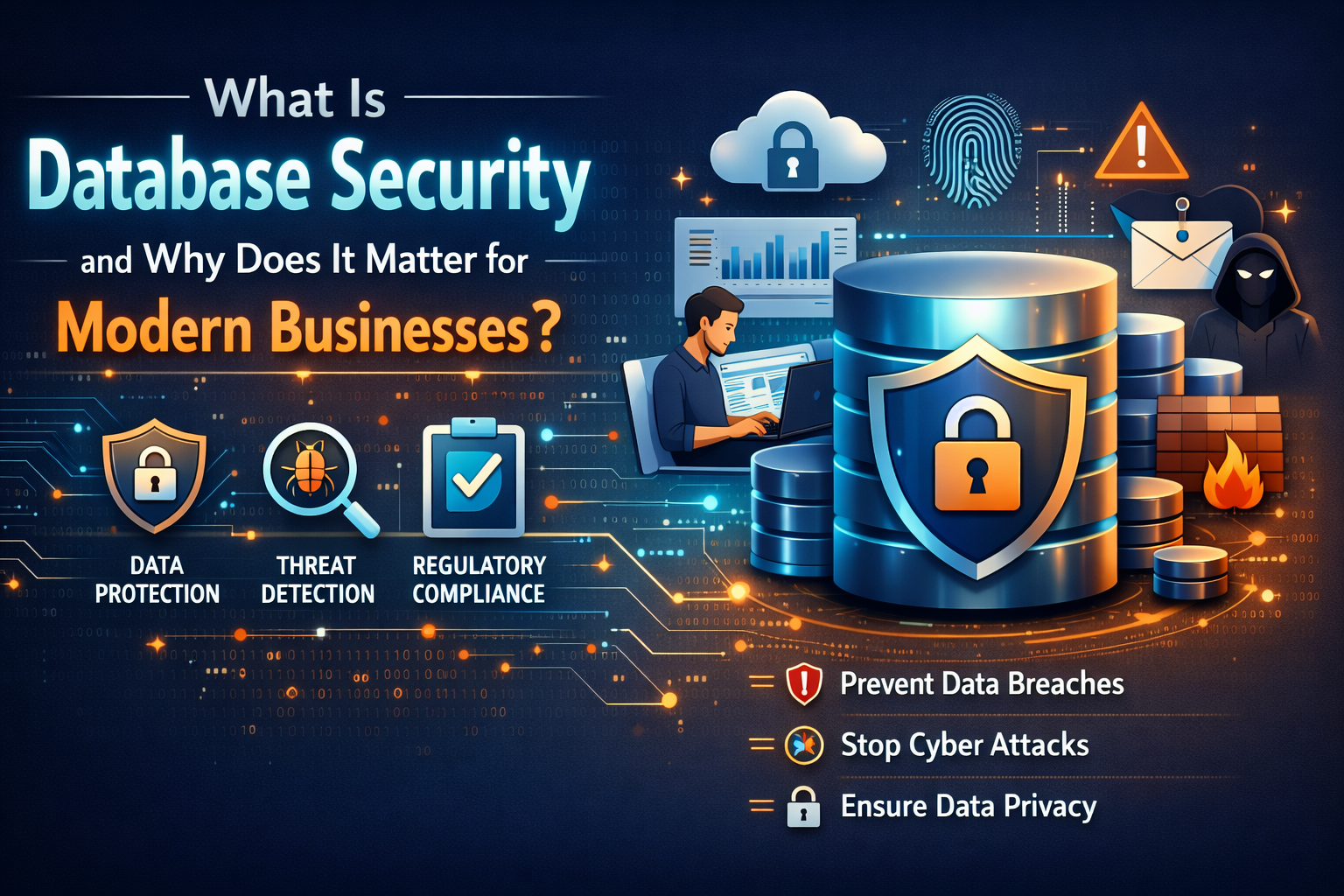
Every modern business runs on data. Customer records, payment details, employee information, internal reports, product data, and operational insights all live somewhere, and in many cases, they sit inside a database. That is exactly why database security matters so much. It is not just an IT issue or a task for security teams. It is a business issue tied to trust, continuity, compliance, and long-term growth.
At its core, database security is the mix of tools, policies, and practices used to protect the data inside a database, the DBMS, the applications connected to it, and the infrastructure that supports it. The goal is simple: keep sensitive information safe from unauthorized access, misuse, damage, and disruption while still making sure authorized people can do their jobs.
What Database Security Actually Means
A lot of people hear the phrase database security and think it just means adding a password to a database server. In reality, it is much broader than that. A secure database environment protects the data itself, the software managing it, the systems connected to it, and the people who can access it. It also has to account for both external attacks and internal mistakes.
Most of the top-ranking pages frame database security around the CIA triad: confidentiality, integrity, and availability. Confidentiality means sensitive data stays private. Integrity means the data remains accurate and untampered with. Availability means authorized users can access the data when they need it. If one of those three breaks down, the business feels it almost immediately.
That is what makes this topic so important for businesses today. A company can survive a lot of small problems, but losing control of its data can trigger legal issues, customer churn, damaged reputation, and expensive downtime all at once. Database security is really about protecting the foundation that modern business operations depend on.
Why Database Security Matters for Modern Businesses
For most businesses, data is not just a technical asset. It is a core business asset. When a database is compromised, the damage can spread far beyond the IT department. You may lose access to critical records, expose customer information, interrupt day-to-day operations, or create compliance problems that cost time and money to fix. IBM and HPE both emphasize that weak protection can lead to loss of trust, exposure of proprietary information, and harm to brand reputation.
This matters even more now because businesses store more data than ever before and often do so across cloud, multi-cloud, and distributed environments. That creates more access points, more complexity, and more room for mistakes. The challenge is no longer just locking down one server in one office. It is managing secure access across systems, teams, devices, and platforms without slowing the business to a crawl.
There is also the trust factor. Customers expect businesses to protect their personal and financial information. Partners expect reliable handling of shared data. Regulators expect controls, logs, and accountability. When a business can show strong access control, encryption, monitoring, and recovery planning, it is not only reducing risk. It is showing that it takes responsibility seriously.
The Biggest Risks Businesses Need to Understand
One reason this topic ranks so well is that it sits at the intersection of technology and everyday business risk. The competitors repeatedly focus on a core set of threats, and for good reason.
The first is unauthorized access. If the wrong user gets into a database, they may view, copy, change, or delete sensitive information. That can happen through stolen credentials, weak passwords, shared accounts, or overly broad permissions. Insider threats are especially important here because they often involve people who already have some level of access. Imperva highlights three common insider scenarios: a malicious insider, a negligent employee, or an outsider who gets hold of internal credentials.
The second major risk is misconfiguration. A database can be exposed not because the business ignored security entirely, but because a setting was wrong, a port was left open, an old account was never removed, or a cloud database was deployed with weak defaults. These kinds of mistakes are common, and they are often exactly what attackers look for first.
Then there is SQL injection and other application-layer attacks. If a web application talks to a database and that application is insecure, attackers may be able to push malicious queries through it. That is why database protection is not only about the database server itself. It also includes the applications, APIs, and services connected to it. Imperva specifically notes that SQL injection attacks aimed at web applications can lead to illicit access to databases, which is why database protection often overlaps with WAF and application security.
Businesses also have to think about ransomware, malware, accidental deletion, hardware failure, and plain old human error. A staff member using a weak password, sharing login details, or deleting records by mistake can be just as dangerous as a sophisticated attacker. That is one reason the best competitor pages keep talking about training, logging, backups, and least-privilege access instead of relying on one “magic” tool.
The Core Elements of Strong Database Security
If you look across the top results, the best practices are remarkably consistent. A strong approach usually starts with authentication and authorization. Businesses need to verify who is trying to access the database and then limit what each user can do. That is where MFA, RBAC, and the principle of least privilege come in. The less unnecessary access people have, the lower the chance of misuse or large-scale damage.
The next big piece is encryption. Sensitive data should be protected both at rest and in transit. That means the information is harder to read even if someone intercepts it or gains access to stored files. Across the competitor pages, encryption, TLS, key management, and secure secrets storage show up again and again because they are foundational controls, not optional add-ons.
After that comes monitoring, auditing, and visibility. Businesses need logs, alerts, and review processes that show who accessed the database, what changed, and whether anything unusual happened. Real-time alerts and anomaly detection can help teams catch suspicious behavior before it turns into a full breach. SIEM, audit logs, and security reporting all support that visibility.
Then there is patching and hardening. Databases and the systems around them should be updated regularly, unnecessary services should be disabled, and known vulnerabilities should be fixed quickly. It sounds basic, but many serious incidents begin with systems that were left outdated or configured too loosely.
Finally, every serious strategy includes backups and disaster recovery. Even the best security setup cannot promise that nothing will ever go wrong. That is why businesses need tested restores, secure backups, and a recovery plan. GeeksforGeeks and InfluxData both stress not just having backups, but testing them so recovery actually works when it matters.
Why This Matters Even More in the Cloud
Modern businesses are increasingly using cloud databases, and that changes the conversation a bit. The cloud can improve scale and resilience, but it also introduces shared responsibility. In simple terms, the provider secures the underlying infrastructure, while the customer still has to secure the data, identities, configurations, and access rules.
That is why cloud database security usually includes IAM, private endpoints, VPC isolation, TLS, KMS, secrets management, monitoring, and automated backup policies. Businesses that move to the cloud without understanding that responsibility split often assume the provider is handling more than it actually is. That assumption can become a very expensive mistake.
What Good Database Security Looks Like in Practice
In practical terms, strong database security is not flashy. It looks like clear access rules, regular permission reviews, secure credentials, encrypted traffic, patched systems, tested backups, and logs that someone actually checks. It also looks like staff training, because even the best technical controls can be weakened by carelessness or phishing.
It also means thinking beyond prevention. Good security assumes that incidents can happen and prepares for them. That is why approaches like Zero Trust, continuous verification, and layered defense are becoming more common. Instead of trusting a user or system just because it is inside the network, businesses verify access continuously and keep permissions narrow. Wiz specifically ties Zero Trust to least privilege and explicit verification to reduce lateral movement and limit breaches.
A Simple Way for Businesses to Get Started
For a business that wants to improve quickly, the first steps are usually straightforward. Review who has access to the database. Remove outdated accounts. Turn on MFA. Tighten permissions with RBAC and least privilege. Encrypt sensitive data. Patch the environment consistently. Monitor activity. Back up everything important. Test recovery. Then repeat those checks on a schedule instead of treating security like a one-time project.That approach may not sound exciting, but it is exactly what separates businesses that recover quickly from businesses that scramble after a breach. The companies that take database security seriously are not just protecting records. They are protecting operations, customer confidence, compliance posture, and the future of the business itself.