

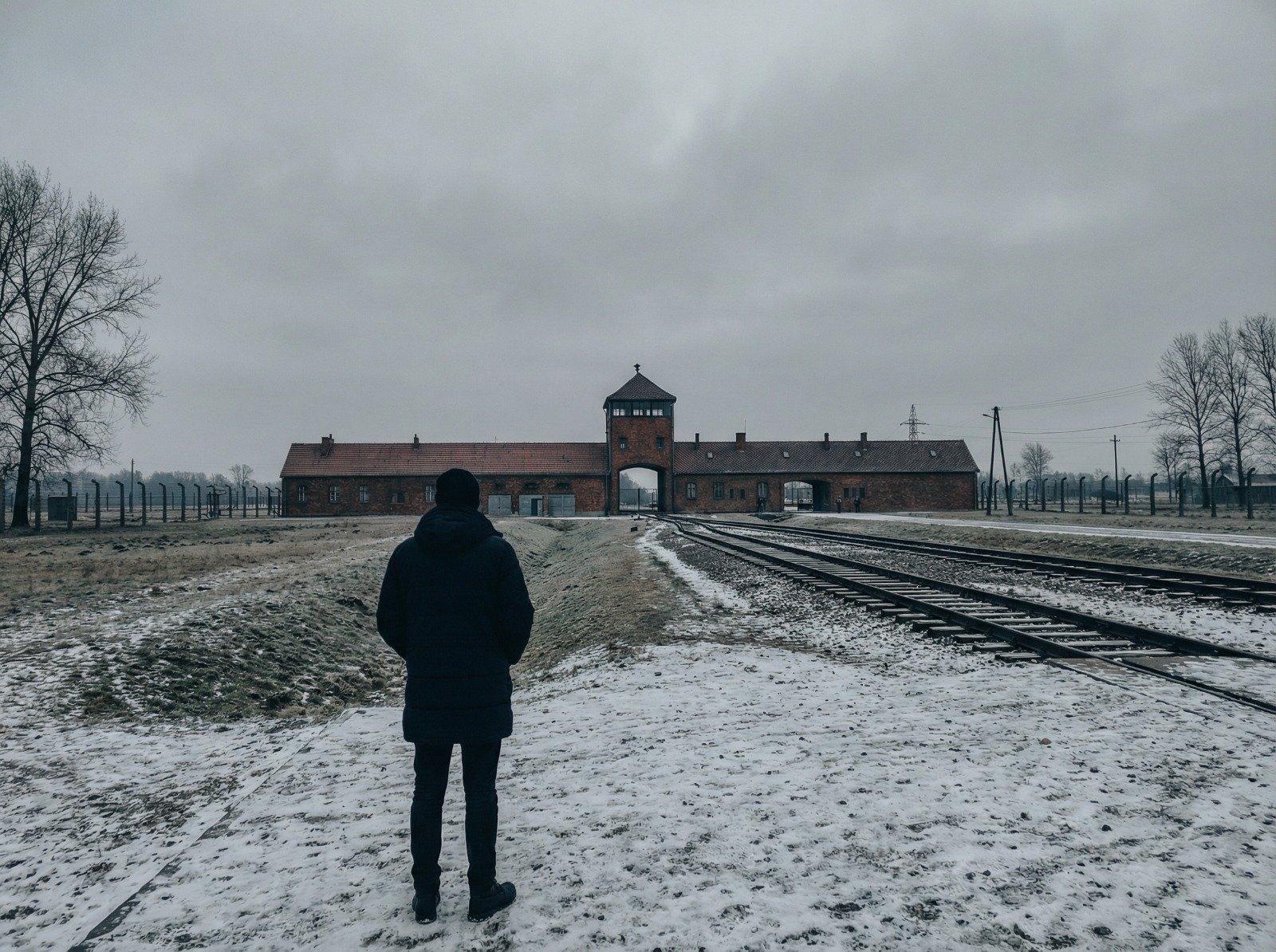
The most powerful ethics lesson for business leaders may not come from a boardroom or a business school – it comes from standing at the gates of Auschwitz. Visiting this site forces executives to confront what happens when institutions abandon moral judgment, when hierarchies replace individual conscience, and when silence becomes complicity. Understanding Auschwitz as an ethical case study reveals patterns that still operate in today’s organizations – and shows how leaders can build structures that prevent moral failure before it happens.
When Institutions Fail: The Historical Foundation Every Business Leader Must Understand
Auschwitz is not only a memorial – it is the world’s most documented case study of how ordinary organizations can enable extraordinary harm. This is exactly why it belongs in conversations about leadership ethics.
Business education still undervalues the corporate dimension of the Holocaust. IG Farben manufactured Zyklon B and operated a synthetic rubber plant using concentration camp labor at Auschwitz III–Monowitz. Siemens, BMW, and Daimler all used forced labor. These were not rogue actors – they were respected institutions with shareholders, managers, quarterly targets, and internal hierarchies. They made decisions within systems that had normalized atrocity step by step.
This is the critical lesson: catastrophic moral failure rarely arrives as a single, obvious choice. It builds through gradual drift – small compromises that each seem manageable in isolation but accumulate into something monstrous.
The Bureaucratization of Evil: What Hierarchies Do to Moral Judgment
Hannah Arendt, observing the trial of Adolf Eichmann in 1961, introduced a phrase that has never lost its relevance: the banality of evil. Eichmann was not a monster in the conventional sense. He was an efficient bureaucrat who followed procedures, respected authority, and advanced his career – replacing personal moral judgment with institutional role-compliance.
Sound familiar?
Research in organizational psychology consistently shows that hierarchical structures diffuse individual responsibility. When everyone follows a process, no one feels personally accountable for the outcome. Psychologist Albert Bandura called this “moral disengagement,” and it operates through recognizable patterns:
- Displacement of responsibility – “I was just following orders / policy”
- Diffusion of responsibility – “Everyone agreed to this decision”
- Euphemistic labeling – “restructuring” instead of mass layoffs, “aggressive accounting” instead of fraud
- Dehumanization of stakeholders – customers or employees reduced to data points
These mechanisms operated inside Nazi bureaucracies. They also operated inside Enron, where executives used complex financial instruments to obscure fraud while mid-level employees rationalized participation. They operated inside Volkswagen, where systemic pressure led engineers and managers to justify their choices. The parallels are not provocative – they are precise.
What Walking Through Auschwitz Teaches That a Classroom Cannot
You can read about Auschwitz. You can study the statistics – 1.1 million people murdered, 90% of them Jewish. You can analyze the organizational charts and corporate contracts. And you will understand it intellectually.
But you will not feel it the way you feel it when you walk through Block 11, or stand beside the ruins of Crematorium II, or see the two tons of human hair displayed behind glass in Block 4.
Physical presence activates a different kind of knowing. Research on empathy shows that visiting a site of historical significance produces stronger, more lasting behavioral shifts than abstract instruction. Leaders who visit Auschwitz consistently report that the experience dismantles a particular form of self-deception: the belief that I would have acted differently, that my organization is fundamentally different.
For those planning a structured visit, KrakowDirect offers guided transport and educational tours from Kraków to Auschwitz-Birkenau, helping participants navigate the site thoughtfully rather than as passive tourists. A well-organized visit – find relevant information at https://benimarco.es/trip-to-auschwitz-from-krakow/ – includes guided interpretation connecting historical events to broader ethical questions, which is essential for translating the experience into professional reflection.
Translating Memory Into Leadership Practice
The question that matters is: what do you do with what you’ve seen?
Build Cultures That Resist Moral Drift
The most important insight from Auschwitz for business leaders is this: ethical failure is rarely sudden. Organizations drift toward harmful behavior incrementally, through processes that feel normal at each step. The antidote is structural, not motivational. Leaders who take this seriously implement:
- Clear, non-negotiable ethical frameworks embedded at every level – not just in a code of conduct nobody reads, but in performance reviews and decision-making processes
- Psychological safety – the organizational condition, researched by Harvard’s Amy Edmondson, in which employees feel safe raising concerns without fear of punishment
- Structural mechanisms for dissent – anonymous reporting systems and explicit protections for those who challenge decisions
Move Beyond Compliance Toward Moral Courage
Compliance asks: are we breaking the rules? Moral courage asks: are we doing what is right, even when it is costly?
Many employees inside organizations that caused serious harm did not lack information – they knew. What they lacked was either the safety to act or the courage to act despite risk. Leaders set the tone. When a CEO acknowledges a mistake, absorbs accountability, and changes course, that behavior cascades through the organization. When a senior manager dismisses an ethical concern as “not our problem,” that also cascades. Visible ethical behavior from leadership is not decoration. It is architecture.
The Social Contract of Business
The corporate actors who supported the Nazi regime were not acting illegally under the laws of the time. In many cases, they acted in strict accordance with shareholder interests and government contracts. This is precisely why the lessons cannot reduce to legality alone.
Modern ESG frameworks and the UN Guiding Principles on Business and Human Rights (2011) reflect the growing recognition that businesses operate within a social contract that extends beyond shareholder returns. Auschwitz illustrates, with brutal clarity, what it looks like when businesses opt out of that contract entirely. It demands that today’s leaders ask not only “is this profitable?” and “is this legal?” – but also “is this something we could defend to history?”
The Legacy You Are Building Starts Now
Every leader inherits an organization with a culture already in motion. The question is whether you examine that culture critically – building structures that protect ethical judgment and hold authority accountable – or allow the machinery to run on momentum.
The business leaders who signed off on labor arrangements at Monowitz were not, most of them, sadists. They were professionals making decisions inside institutional systems that had normalized the unthinkable. You are also making decisions inside institutional systems. The difference is that you have the benefit of knowing how those stories ended.
Engage with Holocaust education. Visit Auschwitz if you have the opportunity – KrakowDirect can help you plan a structured, educational visit that honors the gravity of the site. Commit to ongoing ethical reflection rather than a one-time training exercise. And ask yourself the question that Auschwitz ultimately puts to every leader who walks through its gates:
What would I have done – and what will I do now?