

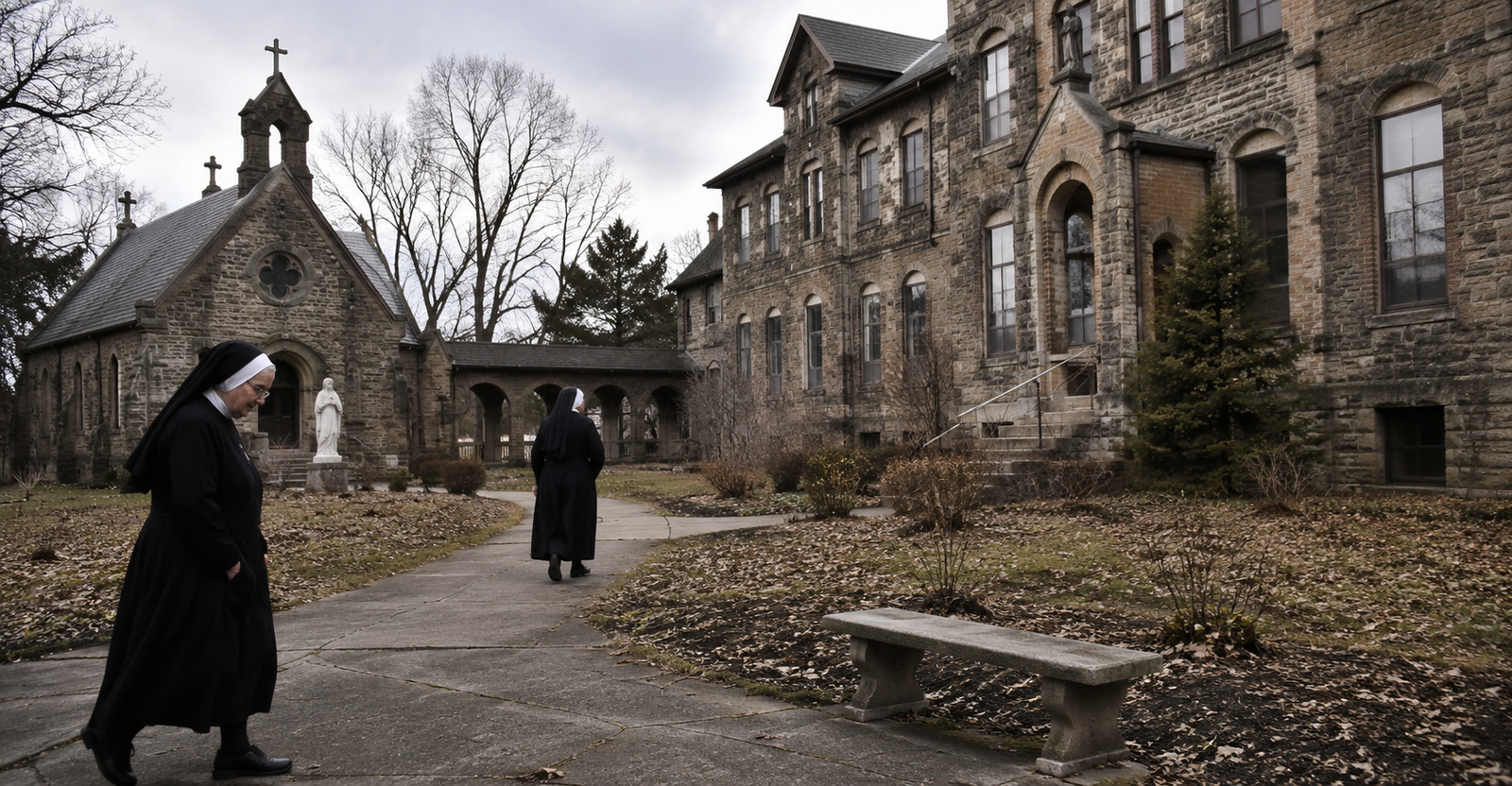
The phrase the vanishing nuns of Delaware County sounds almost like the title of a mystery, but the real story is quieter, more human, and deeply tied to faith, aging, service, and change. In Aston, Pennsylvania, the Sisters of St. Francis of Philadelphia have been part of local Catholic life for generations. They built schools, cared for the sick, taught children, prayed with families, and served people who often had nowhere else to turn.
Today, their presence is still meaningful, but it is also much smaller than it once was. Fewer young women are entering religious life. Many sisters are now elderly. Convents that once held large communities have become quieter. That is why searches for vanishing nun Delaware County, vanishing nuns of Delaware County, and the vanishing nuns of Delaware County have drawn public attention.
The Philadelphia Inquirer’s 2025 feature on the Sisters of St. Francis described a community still active in prayer and service, but facing the reality of aging members, rising healthcare costs, and fewer new vocations. The article reported that the congregation had about 270 sisters, with only around 30 living in the motherhouse at Our Lady of Angels Convent in Aston and roughly 80 living across the street at Assisi House, the retirement convent.
Why This Story Matters in Delaware County
Delaware County has a long Catholic history. For decades, religious sisters were visible in schools, hospitals, parish life, nursing, social work, and community service. Many families remember sisters as teachers, principals, nurses, mentors, and steady spiritual figures.
The Sisters of St. Francis of Philadelphia are especially connected to Aston and Neumann University. Neumann University notes that the congregation was founded in Philadelphia in 1855 by Mother Francis Bachmann under the direction of St. John Neumann, and that the sisters have served for more than 150 years wherever needs existed.
That kind of history makes the decline feel personal. This is not only about buildings or numbers. It is about a way of life that shaped local Catholic education, charity, and community identity.
Who Are the Sisters of St. Francis of Philadelphia?
The Sisters of St. Francis of Philadelphia are a Catholic community of women religious based in Aston, Pennsylvania. Their official site describes them as more than 250 Catholic women religious who choose a Gospel way of life. The same site lists their address as 609 S. Convent Road in Aston.
Their work has not been limited to prayer inside convent walls. Over the years, sisters have taught, provided healthcare, supported the poor, worked with immigrants, advocated for environmental care, and served through many ministries.
The Inquirer reported that some sisters at Assisi House, although technically retired, continue what the community calls “prayer ministry.” Their work includes writing to prisoners, preparing food for distribution, and responding to prayer requests.
That detail is important because “vanishing” does not mean inactive. Many sisters may be older, but they are still serving in ways that fit their age, health, and spiritual calling.
The Reality Behind “Vanishing Nuns”
The phrase vanishing nuns of Delaware County points to a visible shift. There are fewer sisters than in previous generations, and the average age is much higher. The decline is part of a national pattern, not just a local issue.
AP reported that the number of Catholic nuns in the United States peaked in 1965 at 178,740 and had fallen to 39,452 by 2022, citing data from Georgetown University’s Center for Applied Research in the Apostolate. AP also noted that only between 100 and 200 young women enter religious vocations each year in the U.S., and not all complete the process.
That wider trend helps explain what is happening in Delaware County. The sisters did not suddenly disappear. Their numbers changed slowly over decades as fewer young women entered the convent and many older sisters reached retirement age.
A Changing Catholic World
In the mid-20th century, Catholic sisters were highly visible in American life. Many Catholic schools were staffed largely by sisters. A child could grow up seeing sisters in classrooms, hospitals, parishes, and neighborhood ministries.
Today, that experience is less common. Catholic schools are more often staffed by lay teachers. Hospitals and social service agencies have professional employees instead of large communities of sisters. Young Catholic women also have many life paths available to them that were less accessible generations ago.
The Inquirer’s reporting explained that many older Sisters of St. Francis entered religious life as teenagers, often influenced by Catholic school teachers or family members who were already sisters. That social world has changed, making religious life less visible to younger generations.
This does not mean faith has disappeared. It means the structure of religious life has changed.
The Motherhouse, Assisi House, and Neumann University
The Aston campus is central to this story. The Inquirer described Our Lady of Angels Convent as a castle-like motherhouse on a large green campus, now owned by Neumann University. Neumann rents office and housing space to the sisters, while Assisi House across the street serves as a retirement convent.
Neumann University itself is part of the sisters’ legacy. The university says the Sisters of St. Francis founded it in 1965 as Our Lady of Angels College, and it later became Neumann University.
That connection makes the campus more than a property story. It is a living example of how religious communities created institutions that continued to serve long after the number of sisters began to decline.
Why Fewer Women Are Becoming Nuns
There is no single reason why fewer women enter convents today. The decline comes from many social, cultural, economic, and religious changes.
Some young women may not have grown up around sisters, so the vocation feels unfamiliar. Others may feel called to marriage, careers, activism, teaching, healthcare, or service outside formal religious life. Student debt can also make it harder for a young woman to enter a religious community, because many orders require debts to be resolved before formation. AP has reported that debt is one barrier for some women discerning religious life.
The formation process itself is also long. AP reported that becoming a nun can take about 7 to 10 years, and not everyone who begins completes the journey to final vows.
For many communities, this means the number of new sisters is not enough to replace the number of sisters who die each year.
The Cost of Aging Communities
Aging is not only emotional. It also creates practical challenges. Older sisters need healthcare, assisted living support, accessible housing, transportation, and long-term care. The Inquirer reported that longer lifespans, high healthcare costs, and fewer new sisters have made finances difficult for congregations across the country.
This is one reason convents and religious residences sometimes change purpose, consolidate, or close. Buildings that once held large communities may become too expensive to maintain for a smaller group. Some sisters move into retirement homes. Others relocate when church or school properties are sold or repurposed.
A 2017 CBS Philadelphia report showed a similar local challenge when religious sisters from four congregations who had lived on the Cardinal O’Hara High School campus in Springfield Township were being forced to relocate after decades there.
What the Sisters Still Do Today
The story should not be read only as decline. The Sisters of St. Francis are still active. Their official site shares news, mission updates, and information about their documentary, No Risk, No Gain: The Sisters of St. Francis of Philadelphia.
The Inquirer also reported that sisters continue to teach English as a second language, distribute hot meals, work in healthcare, and advocate for clean air and water.
That ongoing service is central to understanding the story. The number of sisters may be smaller, but their identity is still built around faith in action.
Why the Phrase “Nuns” Can Be Misleading
Many people use the word “nuns” for all Catholic women religious, but there is a technical difference. In everyday language, “nun” is often used broadly. In Catholic terms, some women are sisters who work in active ministries, while nuns often live a more cloistered or contemplative life.
The phrase vanishing nun Delaware County is likely popular because it is easy to search and easy to remember. But in this local case, the story is mainly about the Sisters of St. Francis of Philadelphia, a community of religious sisters with a long history of active ministry.
For SEO, it is fine to acknowledge the common keyword, but the article should also use accurate terms like Catholic sisters, women religious, religious life, convent life, and Sisters of St. Francis.
Delaware County’s Convent Memory
For older residents, convents were once part of everyday life. A sister might have taught reading, led a classroom prayer, visited a sick family member, managed a school office, or helped a parish event run smoothly.
That visibility created trust and familiarity. Even people who were not Catholic often recognized sisters as part of the local social fabric. Their decline is one of those changes that can feel quiet until people suddenly notice the difference.
This is why the vanishing nuns of Delaware County has become a compelling topic. It reflects not only a religious shift, but also a cultural memory. People are asking what happened to a group of women who were once everywhere in Catholic community life.
A Story of Loss, But Not Disappearance
The word “vanishing” can sound final, but the sisters themselves are not gone. Their numbers are lower, their lives are quieter, and their ministries may look different, but their influence remains in schools, universities, social programs, former students, parish memories, and generations of families.
Delco Today summarized the Inquirer feature by noting that the Sisters of St. Francis in Aston have been around for 170 years and are now facing a fading presence after surviving wars, pandemics, and major historical changes.
That long history gives the story a deeper meaning. Institutions change. Vocations change. Buildings change. But the spiritual and social impact of the sisters does not disappear overnight.
What Comes Next for Local Convents?
The future of convent life in Delaware County may not look like the past. There may be fewer large motherhouses and fewer sisters teaching in classrooms. Some buildings may be shared, rented, sold, or adapted for new uses. Some ministries may be carried forward by lay partners, employees, volunteers, alumni, and companion groups.
The Sisters of St. Francis already show signs of that transition. Their official site includes news and ways for supporters to stay connected, while their public ministry continues through prayer, service, advocacy, and storytelling.
The future may be smaller, but it is not empty.
Search Terms Connected to This Story
This topic naturally connects with related phrases such as:
vanishing nun Delaware County
vanishing nuns of Delaware County
the vanishing nuns of Delaware County
Sisters of St. Francis Aston PA
Sisters of St. Francis of Philadelphia
Our Lady of Angels Convent
Assisi House Aston
Catholic sisters in Delaware County
decline of Catholic nuns
women religious in America
convent life today
Neumann University Sisters of St. Francis
Catholic religious life decline
These terms should be used naturally, not repeated too often. The strongest content is not just keyword-rich; it helps readers understand the real story behind the search.
Why Readers Are Drawn to This Topic
People are drawn to this story because it combines history, faith, nostalgia, and uncertainty. It raises questions that go beyond one convent in Aston.
What happens when a religious community grows old?
Who carries on its work?
What becomes of the buildings and traditions?
How do local memories survive when the people who shaped them are fewer each year?The story of the vanishing nuns of Delaware County is not only about decline. It is about a community that gave much of its life to service and is now asking what faithful presence looks like in a different era. The sisters may be fewer, but their legacy remains visible in Delaware County’s schools, churches, families, and institutions.