

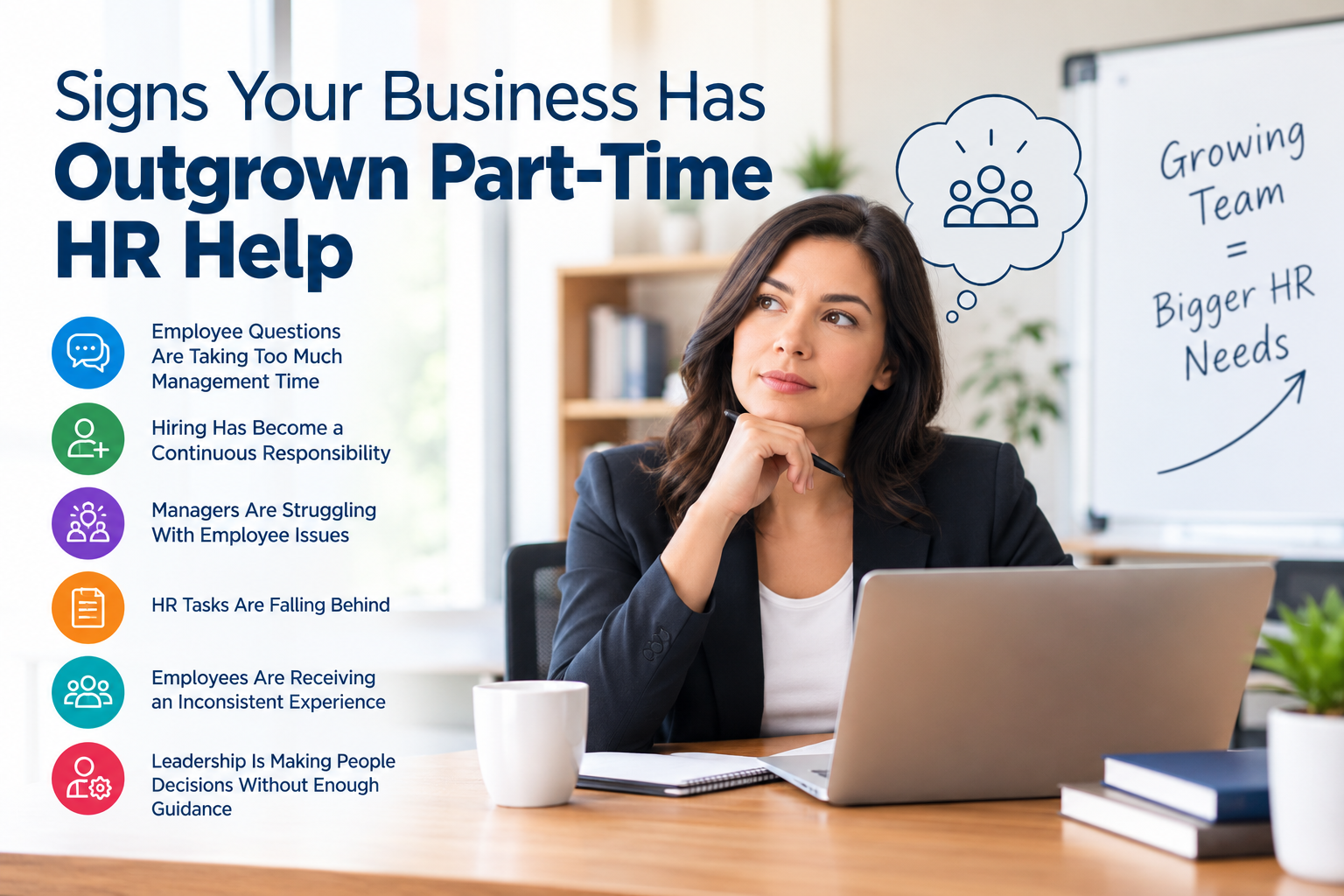
Many small businesses begin managing human resources with a simple approach. The owner handles employee questions, a manager coordinates hiring, and an outside HR professional provides occasional support when something more complicated comes up. In the early stages, this arrangement can be practical and cost-effective.
As a company grows, however, its workforce becomes more difficult to manage through occasional assistance alone. Hiring increases, managers take on greater responsibilities, employee concerns become more frequent, and internal processes need more structure. What once worked well may no longer provide the consistency the business needs.
Recognizing the signs that your company has outgrown part-time HR help can help you decide when to expand your support and build a stronger foundation for continued growth.
1. Employee Questions Are Taking Too Much Management Time
One of the first warning signs is that routine employee questions regularly interrupt the workday. Managers may spend hours answering questions about onboarding, time-off procedures, workplace expectations, benefits, or internal policies.
When these questions are handled informally, employees may receive different answers depending on whom they ask. Managers can also struggle to balance employee support with their primary responsibilities.
A more structured HR process can provide employees with clear information and give managers a reliable point of contact. If leadership repeatedly finds itself handling the same questions, it may be time to evaluate whether the current HR arrangement offers enough ongoing support.
2. Hiring Has Become a Continuous Responsibility
Recruitment is often manageable when a company fills only a few positions each year. As the business expands, hiring can become a continuous process involving multiple departments, interviews, candidate communication, onboarding, and workforce planning.
Without consistent coordination, job descriptions may become outdated, interview processes may vary between managers, and promising candidates may lose interest because of delays.
Businesses should review whether their current HR support can manage the full recruitment process while helping leaders identify future staffing needs. If hiring activities repeatedly fall behind or managers are spending too much time coordinating recruitment, additional HR capacity may be necessary.
3. Managers Are Struggling With Employee Issues
As teams grow, managers inevitably encounter more situations involving communication problems, performance concerns, workplace disagreements, and employee dissatisfaction.
Part-time HR support may be sufficient for occasional questions, but it can become difficult to provide timely guidance when several issues arise simultaneously. Managers may delay difficult conversations or make inconsistent decisions because they are unsure how to proceed.
Businesses benefit from giving managers a clear process for raising concerns, documenting important discussions, and seeking guidance when needed.
If managers frequently feel unprepared to handle employee situations, the company may need more accessible HR expertise rather than relying solely on occasional consultations.
4. HR Tasks Are Falling Behind
Another sign is a growing backlog of administrative work. Employee records may be incomplete, onboarding checklists may not be updated, job descriptions may no longer reflect actual responsibilities, and internal procedures may remain undocumented.
These problems often develop gradually. Because they do not always create an immediate disruption, they can be overlooked until several issues accumulate.
A growing business should periodically review the condition of its HR processes. Identify recurring tasks, assign clear ownership, and determine which activities need regular attention rather than occasional review.
If essential HR administration is consistently postponed, the company may have reached the limits of its existing support arrangement.
5. Employees Are Receiving an Inconsistent Experience
Employees notice when workplace processes vary from one department or manager to another. One team may receive structured onboarding, while another learns through informal conversations. Performance discussions may happen regularly for some employees but rarely for others.
Inconsistency can create confusion and make employees uncertain about expectations, development opportunities, and how decisions are made.
As the workforce grows, businesses need repeatable processes that help employees receive clear information and appropriate support. This does not require a complicated HR department. It requires dependable systems that managers can follow.
When employees repeatedly report confusion about workplace procedures, it may be time to strengthen the company’s HR infrastructure.
6. Leadership Is Making People Decisions Without Enough Guidance
Business owners often develop strong instincts about hiring, team development, and workplace culture. However, decisions become more complex as the organization adds employees, managers, and departments.
Leadership may need to evaluate staffing priorities, improve performance management, clarify responsibilities, or determine how to support employees through organizational changes.
Occasional HR assistance may answer immediate questions without providing the ongoing perspective needed to improve these processes over time.
For businesses considering their next stage of growth, talentohrpartners is one resource to explore when evaluating options for more structured HR support.
The goal is to ensure that people-related decisions support the company’s broader objectives instead of being handled only when a problem appears.
7. Employee Retention Has Become a Concern
Frequent resignations, repeated recruitment cycles, and difficulty keeping experienced employees can indicate that a company needs to examine its employee experience more closely.
Compensation and career opportunities may be part of the picture, but other factors can also influence retention. Employees may feel that expectations are unclear, communication is inconsistent, or managers do not have enough time to support their teams.
HR can help businesses identify recurring themes in employee feedback, improve onboarding, create clearer development conversations, and encourage managers to address concerns early.
If the company is repeatedly replacing employees without understanding why they leave, more consistent HR support may help leadership identify the underlying issues.
8. Growth Plans Are Outpacing Internal Processes
A company preparing to open another location, introduce a new service, or expand into a different market should consider whether its people-management processes can support that change.
Processes that work for a small, closely connected team may become difficult to maintain when employees are spread across departments or locations. Informal communication may no longer be sufficient, and managers may need clearer guidance about responsibilities and decision-making.
A practical growth plan should include an assessment of hiring needs, management capacity, onboarding processes, employee communication, and the systems required to support the expanding workforce.
If HR planning consistently happens after operational decisions have already been made, the business may benefit from a more proactive and ongoing approach.
9. You Cannot Clearly Define What Your HR Support Covers
Sometimes the problem is not simply the amount of HR assistance available. It is the lack of clarity about what the current arrangement includes.
A business may have access to an outside professional but remain uncertain about who manages recruitment, updates internal procedures, supports managers, or follows up on employee concerns.
Review the current arrangement and document the tasks that are covered, the responsibilities that remain with internal staff, and the response times the business can reasonably expect.
This review provides a practical starting point for identifying gaps. It may reveal that the existing service needs to be expanded, responsibilities need to be reassigned, or the business needs a different combination of internal and external support.
How to Decide What Comes Next
Recognizing these warning signs does not automatically mean hiring a full-time HR employee. The right solution depends on the company’s size, budget, operational complexity, and the amount of support managers need.
For some businesses, expanded outsourced HR support may be enough. Others may benefit from a dedicated internal HR professional or a combination of internal leadership and external expertise.
Start by listing the recurring HR tasks that are delayed, the employee issues that require frequent attention, and the responsibilities currently handled by business owners. Then identify which gaps create the greatest disruption and prioritize those first.
For a practical look at the warning signs, business leaders should consider not only how much HR work exists today but also whether the current approach can keep pace with their growth plans.
Conclusion
Part-time HR help can be an effective solution during a company’s early stages, but growing teams often need more consistent processes, accessible guidance, and forward-looking workforce planning.
Repeated administrative delays, increasing hiring demands, inconsistent employee experiences, and managers who lack HR guidance are all reasons to review the current arrangement.
By identifying these issues early, business owners can choose an appropriate level of HR support before everyday challenges become larger operational problems. The objective is not to add unnecessary complexity. It is to build a people-management approach that supports employees, helps managers work effectively, and gives the business room to grow.