
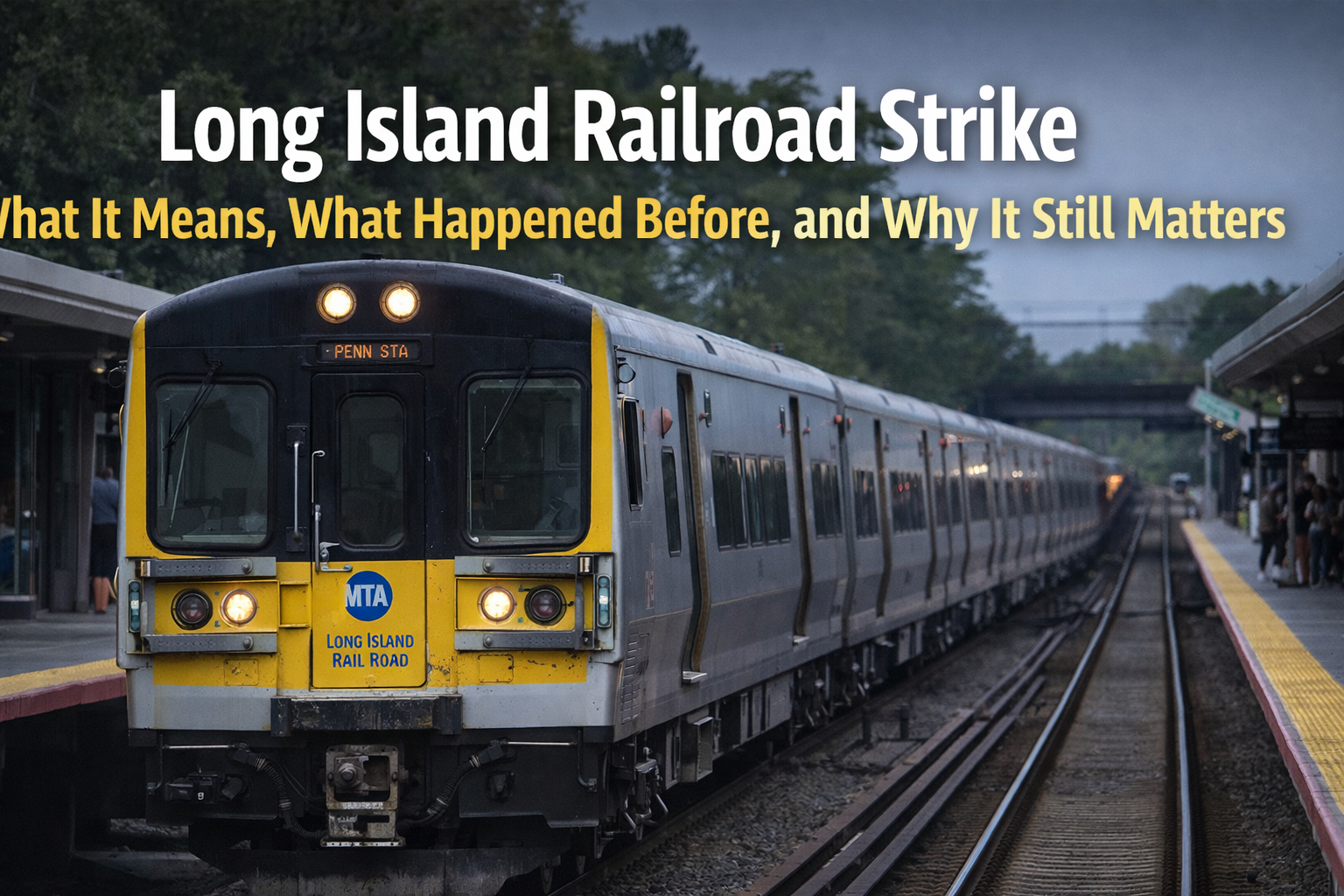
The phrase long island railroad strike usually brings up one big question: is the Long Island Rail Road, or LIRR, actually on strike, or is a strike only being threatened? As of April 19, 2026, there is no active LIRR strike, but there is a serious labor dispute hanging over the railroad, and workers from five unions could legally strike as early as May 16, 2026 if no agreement is reached. That possibility matters because the LIRR serves nearly 300,000 riders a day, making it one of the busiest commuter rail systems in the country.
For commuters, businesses, and anyone who depends on travel between Long Island and New York City, even the threat of a strike is a major story. The railroad is not easy to replace with buses, cars, or subway connections. That is why every time contract talks break down, the issue quickly becomes bigger than wages and work rules. It turns into a regional transportation problem with real economic consequences.
Why the Long Island Rail Road Is So Important
The Long Island Rail Road is central to daily life for many people in Nassau County, Suffolk County, Queens, and Manhattan. It carries commuters to work, students to school, travelers to airports, and visitors to beaches, stadiums, and business districts. Because of that, a work stoppage on the LIRR does not stay limited to the railroad itself. It spills onto highways, bridges, subway lines, and local bus routes almost immediately.
The MTA has said openly that full rail service cannot be replaced in the event of a strike. In a 2025 contingency announcement, the agency said it would offer only limited shuttle bus service from Bellmore, Hicksville, and Ronkonkoma to subway connections in Queens, while strongly urging riders to work from home or avoid unnecessary travel. That language alone shows how disruptive a real strike would be.
The Last Actual Long Island Railroad Strike
When people search for long island railroad strike, they are often trying to understand whether this has happened before. The answer is yes. The last actual LIRR strike took place on June 17, 1994. According to Cornell University Library’s Kheel Center, conductors and maintenance workers walked out after roughly two and a half years without a contract. The strike centered on disputes over pay rates and work rules, and it lasted two days before Governor Mario Cuomo and his aides stepped in to impose a settlement.
That short duration sometimes makes people think the 1994 strike was minor, but it left a lasting impression because it showed how quickly the region can be thrown into chaos when the railroad stops moving. It also became the reference point for every later labor standoff, because once a system like the LIRR shuts down, even a brief disruption becomes a major public and political issue.
The 2014 Near-Strike That Never Happened
The next major chapter came in 2014, when the LIRR came close to another shutdown but avoided it. Reporting from that period showed unions representing roughly 5,400 workers warning that service disruptions could begin as soon as July 20, 2014 after negotiations with the MTA broke down. Officials were preparing for a scenario that could affect about 300,000 commuters, and even then they admitted buses could carry only a fraction of regular riders.
That episode matters because it proved how thin the margin is between a tense labor dispute and a transportation emergency. The MTA described any backup plan as inadequate, and commuters were once again encouraged to stay home if possible. In other words, even when a strike does not happen, the threat alone can reshape work schedules, travel plans, and public pressure on both management and labor.
Why Strike Threats Keep Returning
At the heart of most LIRR labor disputes are the same basic issues: wages, benefits, and work rules. The details change from contract cycle to contract cycle, but the larger pattern stays familiar. Workers argue that rising costs and job demands justify stronger pay packages, while management argues that raises must be balanced against operating costs and rules that affect efficiency.
In the current dispute, union leaders representing more than 3,500 workers have said they want a retroactive 9.5% wage increase covering the last three years and an additional 5% raise going forward. The MTA, meanwhile, has linked wage movement to proposed work-rule changes. One issue highlighted in recent reporting involves extra pay for engineers who operate both a diesel and an electric train during the same shift. The agency wants to reduce that payment, while unions have resisted concessions like that.
What Happened in 2025 and Why It Matters in 2026
The current labor tension did not begin this month. In September 2025, a group of five unions had threatened a strike, but President Donald Trump signed an executive order to appoint an emergency board to mediate the dispute. Reuters reported that the move triggered a 120-day period during which no strike could happen, and that a second board could push the cooling-off period into May 2026. That delay is a major reason the present deadline exists.
This part of the story matters because it shows the conflict was postponed, not fully solved. The emergency intervention bought time and prevented an immediate shutdown, but it did not remove the core disagreement. That is why the strike threat has returned in 2026 with so much urgency. The clock simply started ticking again once the legal pause expired.
Where Things Stand Now
As of mid-April 2026, bargaining remains unsettled. ABC7 New York reported that LIRR workers could strike as early as May 16, while News 12 reported that the latest bargaining round ended without an agreement and without a new negotiation session on the calendar at that time. The same reporting said concerns were growing because the deadline was approaching quickly and uncertainty remained high.
Industry coverage has also noted that under the Railway Labor Act process tied to this dispute, the unions could strike on May 16 if no deal is reached, or the MTA could impose a lockout. That means the legal framework is now a key part of the conversation, not just the public arguments over fairness and cost.
What a Strike Would Look Like for Riders
For everyday riders, the biggest takeaway is that a real strike would not mean a smooth substitute system. The MTA has already warned that roads would become heavily congested and commute times would rise sharply. Even with shuttle buses and subway connections, the agency has effectively said the railroad’s capacity cannot be recreated by other modes of transit.
That would likely hit workers with fixed schedules the hardest. People in healthcare, retail, hospitality, construction, and other in-person jobs usually do not have the option to work remotely. So while stay-home advice may reduce pressure somewhat, it does not solve the larger problem for thousands of riders who need reliable daily transportation. This is one reason strike threats on the LIRR generate such strong reactions from commuters and local businesses.
Why the Keyword Still Gets So Much Attention
The reason long island railroad strike remains a heavily searched topic is simple: it combines history, uncertainty, and immediate personal impact. It is not only about labor negotiations in the abstract. It is about whether people can get to work on time, whether summer travel will be disrupted, and whether the region can absorb the loss of such a major commuter line.
It also reflects a broader truth about public transit. Rail systems are most noticeable when they stop. On ordinary days, riders take the schedule for granted. During a strike threat, every train suddenly feels essential. That is why even a two-day strike from 1994 still echoes in the public memory, and why every new contract fight is watched so closely.
FAQs
Is there a Long Island Rail Road strike right now?
No. As of April 19, 2026, there is no active LIRR strike, but workers from five unions could legally strike as early as May 16, 2026 if no contract agreement is reached.
When was the last actual Long Island Railroad strike?
The last actual strike happened on June 17, 1994. It lasted two days and ended after intervention from Governor Mario Cuomo and his aides.
Was there almost another LIRR strike in 2014?
Yes. In 2014, unions and the MTA came close to a shutdown that could have affected about 300,000 commuters, but the strike was ultimately avoided.
Why are LIRR workers threatening to strike?
The dispute involves wages, retroactive pay, and work rules. Workers say compensation has not kept up, while the MTA says raises should come with changes to costly or outdated labor rules.
How many riders would be affected by a strike?
The MTA and Reuters have both described the LIRR as serving nearly 300,000 daily passengers, so the impact would be very large.
Would buses replace all train service during a strike?
No. The MTA has said only limited shuttle bus service would be available and has warned that roads would be extremely congested.
Why is the current strike deadline May 16, 2026?
That date is tied to the labor process that followed the 2025 emergency mediation board, which delayed any work stoppage and pushed the dispute into a new cooling-off timeline ending in May 2026.