

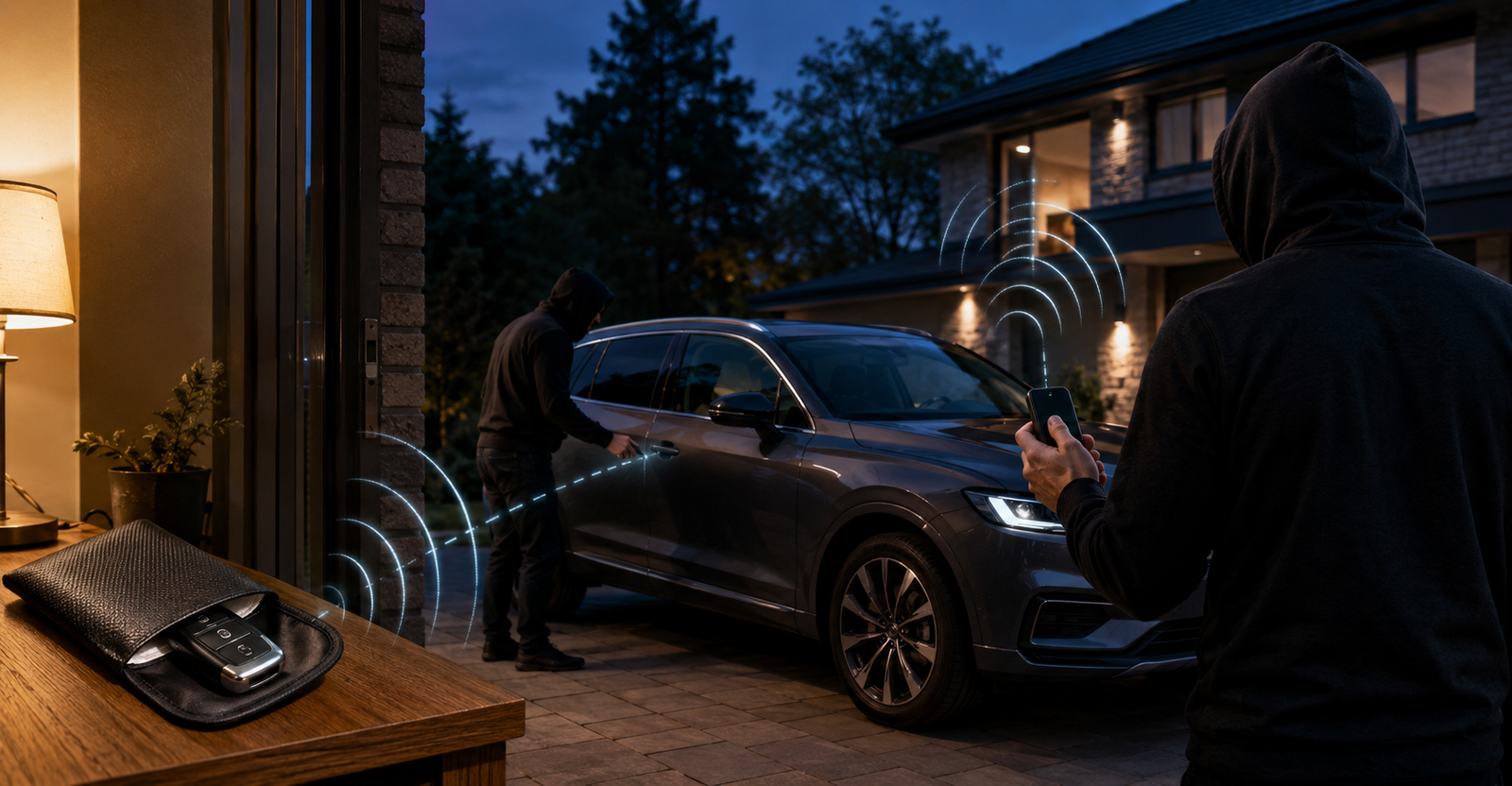
Keyless cars are built for convenience. You walk up to the vehicle, touch the handle, press a button, and drive away without taking the key fob out of your pocket. It feels modern, simple, and safe. But that same convenience has created a serious security problem: thieves are stealing keyless cars in minutes, often without smashing a window, forcing a lock, or using the original key.
For many drivers, the idea sounds almost impossible. How can a thief steal a car if the key is inside the house? How can a locked vehicle disappear from a driveway so quickly? The answer usually comes down to the way keyless entry systems communicate with the key fob.
A modern keyless car is always trying to check whether the correct fob is nearby. If the signal appears close enough, the car may unlock or start. Criminals target that small window of trust. They do not always need to physically steal the key. In some cases, they only need to trick the car into believing the key is close.
That is why searches like thief stealing keyless car, thieves stealing keyless cars, and keyless car theft prevention have become so common. Drivers want to understand the risk and, more importantly, how to protect their vehicles before it happens to them.
Why Keyless Cars Are Being Targeted
Keyless cars are attractive to criminals because they can sometimes be taken quickly and quietly. Traditional car theft often involved breaking into the vehicle, damaging the ignition, forcing the steering lock, or making a lot of noise. Keyless theft can look much calmer from the outside. A thief may approach the car, unlock it without obvious damage, start it, and leave before neighbors notice anything unusual.
This does not mean every keyless vehicle is easy to steal. Car security varies by brand, model, year, software, and anti-theft features. Some newer vehicles have better protections than older systems. Still, the rise of electronic theft has made many drivers rethink how they store keys and secure their cars at home.
The biggest issue is that many people treat a key fob like an ordinary key. They leave it on a hallway table, near the front door, beside a window, or close to the garage. That may be convenient, but it can also make the fob’s signal easier to target.
How Keyless Car Theft Works in Simple Terms
Most keyless thefts are based on signal manipulation. A key fob sends or responds to a wireless signal. The car checks for that signal when someone tries to unlock or start it. If the vehicle thinks the fob is nearby, it may allow access.
In a relay-style theft, criminals use electronic equipment to extend or repeat the signal from the key fob to the car. The vehicle is fooled into thinking the key is close, even if it is actually inside the house. This can allow the car to unlock and start without the thief ever touching the real key.
There are also reports of criminals using advanced tools to clone or capture key fob information in certain situations. The exact methods vary, and not every theft works the same way. But the basic idea is similar: criminals are exploiting the wireless relationship between the car and the fob.
For safety, drivers do not need to know the technical details criminals use. What matters is understanding the risk and blocking the easiest opportunities.
Why These Thefts Can Happen So Fast
People are shocked when they hear that thieves are stealing keyless cars in minutes, but the speed makes sense once you understand the goal. The thief is not trying to hotwire the car like in old movies. They are trying to make the vehicle believe the correct key is present.
If the signal trick works, the car may behave as if the rightful owner is opening it. That means there may be no broken glass, no alarm, and no obvious signs of forced entry. By the time someone realizes what happened, the car may already be gone.
This is why driveway thefts are so common in these cases. The vehicle is parked outside, the key fob is inside the home, and the distance between them may be short enough for criminals to exploit. Homes with keys near the front door, windows, or garage entrance can be especially vulnerable.
Common Signs Your Car Could Be at Risk
A keyless vehicle may be more attractive to thieves if it has push-button start, passive keyless entry, high resale value, or a reputation for being targeted. SUVs, pickups, luxury cars, and newer models often get attention because they can be sold, stripped for parts, or shipped quickly.
Your risk may be higher if:
- You park in a driveway or on the street overnight
- Your key fob is stored near doors or windows
- Your car has passive keyless entry
- Your vehicle is a popular theft target in your area
- You do not use any visible anti-theft device
- Your driveway or parking area is dark
- Your car does not have a tracking device
- You leave spare keys near the vehicle
- You assume locking the car is enough
Locking the vehicle is still important, but with keyless theft, locking alone may not stop every risk.
The Mistake Many Drivers Make With Key Fobs
One of the biggest mistakes is leaving the key fob too close to the car. Many people put their keys on a small table by the front door because it is convenient. Unfortunately, that can also make the signal easier to reach from outside.
A better habit is to store your key fob farther inside the home, away from doors, windows, exterior walls, and the garage. This simple change can reduce risk because it makes the signal harder to access.
The spare key matters too. Some people protect the main key but leave the spare in an easy place. Criminals only need one usable signal. Both keys should be stored safely.
Use a Signal-Blocking Pouch or Box
One of the easiest ways to protect a keyless car is to use a signal-blocking pouch, often called a Faraday pouch. These pouches are designed to block the wireless signal from the key fob so it cannot be picked up or relayed.
A Faraday box can work the same way if it is properly made and fully closed. Some drivers use metal containers, but not every container blocks signals well. The safest choice is to use a product made specifically for blocking key fob signals.
After buying a pouch or box, test it. Place the key inside, close it properly, then try to unlock or start the car while standing near the vehicle. If the car still responds, the pouch may not be working correctly or may not be sealed properly.
Keep Keys Away From Doors, Windows and the Garage
Even with a signal-blocking pouch, it is smart to store keys in a safer location. Do not keep them right beside the front door, next to a window, or on a hook near the garage.
Good places to store key fobs include:
- A drawer away from exterior walls
- A bedroom or interior room
- A tested signal-blocking box
- A closed cabinet farther from the driveway
- A secure place where spare keys are also protected
This habit is simple, free, and useful. It may not stop every type of theft, but it can reduce the easiest signal-based risks.
Turn Off Passive Keyless Entry If Your Car Allows It
Some vehicles allow owners to disable passive keyless entry. This means the car may no longer unlock just because the fob is nearby. You may need to press a button on the fob instead.
Not every car has this option, but it is worth checking your owner’s manual or asking the dealer. If you do not need passive entry every day, turning it off can reduce the chance of relay-style theft.
Some key fobs also go into sleep mode when they stop moving for a certain period. This can help reduce signal exposure. If your vehicle has this feature, learn how it works and make sure it is active.
Add a Visible Steering Wheel Lock
A steering wheel lock may feel old-fashioned, but it still has value. Keyless car thieves often want speed. If they see a visible physical lock, they may move on to an easier target.
A steering wheel lock is not perfect, and determined criminals can sometimes defeat physical devices. But it adds time, noise, and hassle. That matters because many thefts are based on speed and low attention.
Visible deterrents can include:
- Steering wheel lock
- Wheel clamp
- Driveway bollard
- Lockable gate
- Security post
- Garage parking
- Motion lights
- CCTV camera
Layered security works better than relying on one method.
Park Smart Whenever You Can
Where you park can affect risk. A car parked in a dark, quiet driveway near the road may be easier to target than one parked in a garage or behind another vehicle.
If possible, park in a locked garage. If you cannot, park in a well-lit area, close to cameras, or behind another car. If you have a driveway, consider using motion lights or visible cameras. Criminals usually prefer places where they can work quickly without being seen.
If you own two vehicles, parking the less-targeted vehicle behind the more valuable one can make theft harder. It may not be convenient, but it can add another barrier.
Use a Tracker or Built-In Vehicle Security App
A tracker will not always stop theft, but it can help recover a vehicle faster. Some modern cars have built-in tracking features through the manufacturer’s app. Others can use aftermarket GPS trackers or hidden tracking devices.
If your car has a connected app, make sure it is activated and that you know how to use it. Keep your login secure with a strong password and two-factor authentication if available.
For aftermarket trackers, choose one that is reliable, well-hidden, and regularly maintained. A dead battery or poorly placed tracker will not help much if the car disappears.
Update Your Car’s Software and Security Features
Many newer vehicles rely on software as much as hardware. Manufacturers may release updates that improve security, fix vulnerabilities, or change how keyless systems behave.
If your car has dealer updates, recall notices, or security improvements available, do not ignore them. Contact your dealer or check the manufacturer’s owner portal. Some updates may be free, especially if they are tied to known security issues.
This is especially important for vehicles that have been publicly linked to theft problems. A simple update may not solve every risk, but it can improve your protection.
Be Careful With Spare Keys and Valet Keys
A spare key left in the wrong place can defeat all other security. Never leave a spare key inside the car, in the glovebox, under a seat, in a magnetic box under the vehicle, or near the garage.
If you bought a used car, check how many keys came with it. If one key is missing and you do not know where it is, ask a dealer or locksmith about reprogramming options. You do not want an old key still connected to your vehicle if you cannot account for it.
Valet keys and emergency keys should also be stored safely. Anything that can unlock or start the car should be treated as important.
What to Do If You See Suspicious Activity
If you see someone walking around cars at night, holding a device, testing door handles, looking into driveways, or acting suspiciously near parked vehicles, do not confront them directly. Your safety comes first.
Instead, note what you can from a safe place. Details like clothing, direction of travel, vehicle description, license plate, time, and camera footage can help police. If a theft is happening, call emergency services or local law enforcement.
If you have security cameras, save footage quickly. Some systems overwrite recordings after a short time.
What to Do If Your Keyless Car Is Stolen
If your vehicle is stolen, act quickly. Call the police and provide the make, model, color, license plate, VIN if available, and any tracking information. Contact your insurance company as soon as possible. If the car has a connected app or tracker, share that information with law enforcement instead of trying to recover the car yourself.
Also check whether personal documents, house keys, garage remotes, or work items were inside the vehicle. If thieves have access to your address or garage opener, you may need to take extra precautions at home.
After a theft, ask the dealer about disabling old keys, updating vehicle security, and changing access credentials for connected services.
Myths About Keyless Car Theft
There are many myths about keyless theft, and some of them give drivers a false sense of safety.
One myth is that a locked car cannot be stolen. Keyless theft targets the electronic system, so the car may unlock without visible damage.
Another myth is that keeping keys indoors is always enough. It helps, but if the keys are near the front door or garage, the signal may still be easier to exploit.
Another myth is that alarms always stop thieves. Some keyless thefts may not trigger an alarm because the car thinks the real key is present.
A better approach is to use several protections together: safer key storage, a signal-blocking pouch, visible physical deterrents, good parking habits, software updates, and tracking.
Why Layered Security Works Best
No single method is perfect. A Faraday pouch helps protect the key signal. A steering wheel lock adds a physical barrier. A tracker helps recovery. Cameras increase visibility. Smart parking makes the car harder to access. Software updates reduce known weaknesses.
Together, these layers make your car less attractive. Criminals often want the easiest target. If your vehicle looks harder to steal than the one down the street, that alone may reduce risk.
Think of it like home security. You do not rely only on a door lock. You may also use lights, cameras, alarms, and good habits. Keyless car security works the same way.
How Car Owners Can Reduce Risk Tonight
You do not need to wait to improve your car’s security. Start with simple steps today.
Move your key fob away from the front door. Protect the spare key too. Use a signal-blocking pouch or box. Test it properly. Park in a well-lit place. Lock the vehicle every time. Remove valuables from sight. Check whether your car allows passive entry to be disabled. Consider a steering wheel lock if your vehicle is a common theft target.
These steps are not complicated, but they make a difference. The goal is not to make your car impossible to steal. The goal is to make it much harder, slower, and less appealing.
Why This Problem Is Not Going Away
Keyless technology is convenient, and drivers like it. Push-button start and passive entry are now common in many modern vehicles. Because of that, criminals continue looking for ways to exploit electronic systems.
Automakers are improving security, but drivers still need to take basic precautions. The easiest target is often the person who leaves the key near the door, parks in a dark driveway, and assumes the factory lock is enough.
The phrase thieves are stealing keyless cars in minutes sounds alarming, but it also points to a practical truth: prevention has to be quick and consistent too. A few daily habits can reduce your risk.
A Smarter Way to Protect a Keyless Car
A keyless vehicle should be treated differently from an older car with a traditional key. The fob is not just a key. It is a wireless access device, and where you store it matters.
If you own a keyless car, build a simple routine. Put the fob in a tested signal-blocking pouch when you get home. Keep it away from doors and windows. Use a visible deterrent if your car is at higher risk. Check for software updates. Park smart. Keep your spare key secure.The rise in thieves stealing keyless cars does not mean drivers are powerless. It means owners need to understand the weak points and close the easy gaps. With better habits and a few security layers, you can make your vehicle a much harder target.