

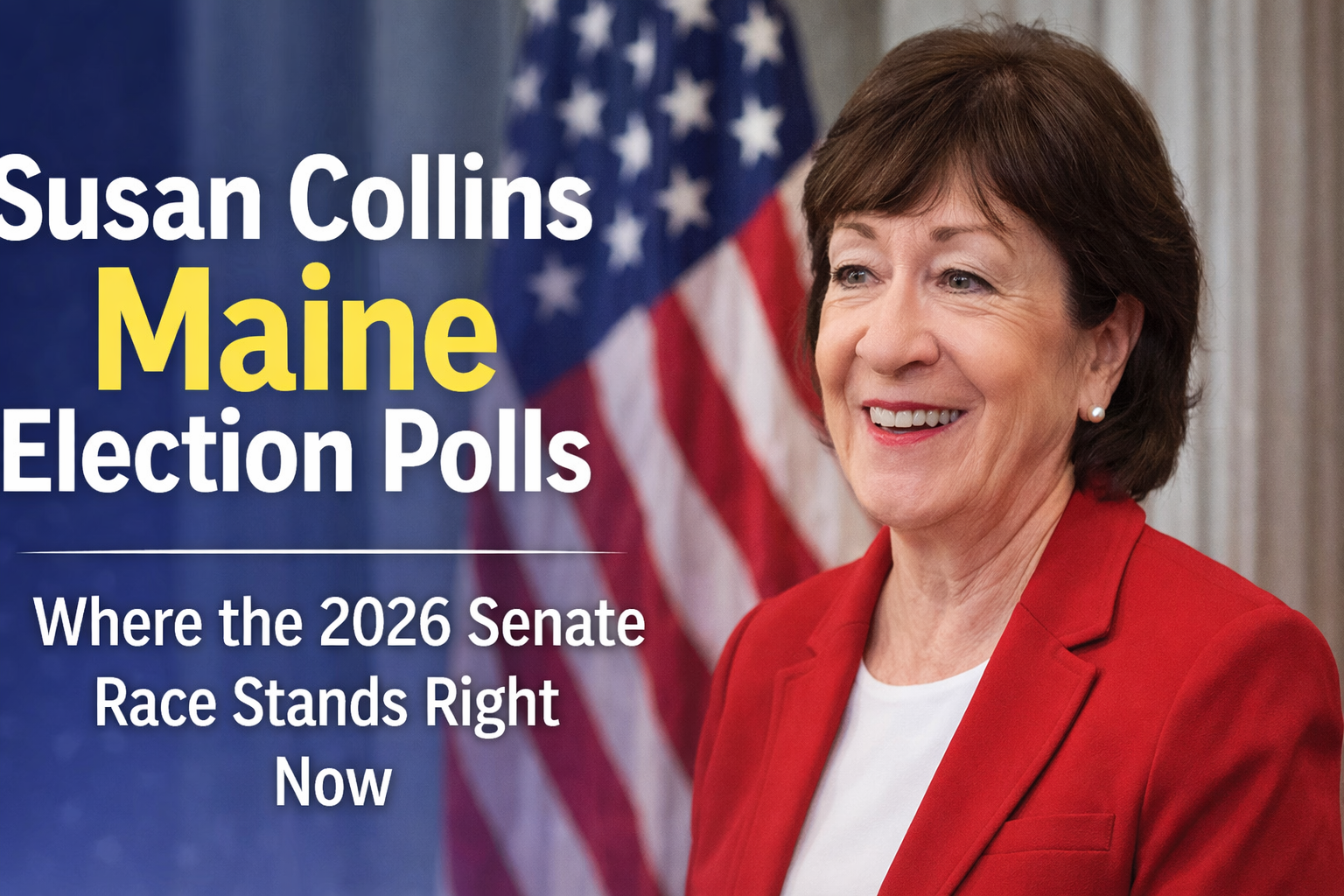
The latest story around Susan Collins Maine election polls is not a simple one. As of April 19, 2026, public polling shows Sen. Susan Collins in a competitive race for a sixth term, but the numbers shift depending on which Democrat is tested against her. In recent polling averages, Collins runs essentially even with Gov. Janet Mills, while she trails Graham Platner by a wider margin. That makes Maine one of the most closely watched Senate contests of the 2026 cycle.
Collins officially launched her 2026 reelection bid in February, setting up another high-stakes contest in a state that often rewards independent-minded voters and close scrutiny of candidates. She has long been known as a Republican with a moderate image, but her current position is more complicated than in past cycles because the electorate is polarized, her favorability has softened, and Democrats still have an unsettled nomination fight on their side.
For anyone searching for Susan Collins Maine election polls, the key point is this: the race is real, the margins are narrow in some matchups, and the polling picture is still evolving because Maine Democrats have not yet chosen their nominee. That means every new poll has to be read in context, not as a final forecast.
What the Latest Maine Senate Polls Show
The clearest polling snapshot comes from 270toWin’s Maine Senate polling page. In the latest average posted there, Graham Platner leads Susan Collins 47.3% to 41.0%, while the average for a Janet Mills vs. Susan Collins matchup is much tighter, with Collins at 43.8% and Mills at 43.3%. That tells us two things at once: Collins is not out of contention, but she is also not sitting in a comfortable incumbent position.
Recent individual polls point in the same general direction. A March 26 Emerson College poll found Platner ahead of Collins 48% to 41%, while Mills led Collins 46% to 43%. A March 9 Quantus Insights poll showed Platner up 49% to 42%, but gave Collins a narrow 45% to 43% edge over Mills. Earlier, a February University of New Hampshire Pine Tree State Poll found Platner leading Collins 49% to 38%, while Mills led Collins 41% to 40%.
That pattern matters. Collins appears more vulnerable against Platner in public polling than against Mills, though even the Mills matchup is close enough to be volatile. A later April 7 Maine People’s Resource Center poll pushed the contrast further, showing Platner at 48% and Collins at 39%, while the same poll put Collins ahead of Mills 45% to 42%. Taken together, the numbers suggest Collins is facing a serious race, but also that the final shape of the contest depends heavily on who emerges from the Democratic primary.
Why the Democratic Primary Matters So Much
The Democratic primary has become one of the biggest reasons the Maine Senate polling story looks unusual. According to 270toWin’s current Democratic primary average, Graham Platner leads with 53.0%, while Janet Mills is at 31.3%. Individual polls have shown Platner ahead by anything from single digits to a very large margin.
The UNH Pine Tree State Poll released on February 24 found Platner dominating the Democratic primary field with 64%, compared with 26% for Mills. Then, on March 26, Emerson College showed Platner still clearly ahead at 55% to 28%. Bangor Daily News described those results as another sign that Mills could face a steep climb if she wants to become the Democratic nominee.
This is why searchers looking up Susan Collins Maine election polls should be careful not to read every general-election number as if the nominee were already locked in. Maine still has a live Democratic contest, and the official state primary is scheduled for June 9, 2026. Until that happens, Collins is effectively running against more than one possible race.
Collins Still Has Important Advantages
Even with the difficult numbers, Collins is not entering this race without strengths. She is the incumbent, she has won statewide many times, and she still dominates her own party’s primary. In the UNH February poll, Collins had 67% support in the Republican primary, showing that she remains the clear favorite with Republican voters in Maine.
She also has major financial and institutional support behind her. Bangor Daily News reported that the Senate Leadership Fund had pledged at least $42 million to help defend her seat, and later reporting said Republican interests had reserved roughly $57 million in ads through Election Day, well ahead of Democratic counterparts at that stage. That kind of outside support can matter a lot in a state where media spending can shape the tone of the campaign early.
Collins has also tried to frame her campaign around experience and influence. Reuters reported that when she announced her reelection bid, she presented herself as a centrist focused on practical solutions. Bangor Daily News also noted that she could become Maine’s longest-serving U.S. senator if she wins again. More recently, local reporting said she indicated a sixth term could be her last, though her campaign later described that remark as offhand rather than a formal retirement pledge.
Why Poll Watchers Are Still Being Careful
There is another reason analysts are cautious when talking about Susan Collins Maine election polls: she has beaten the polls before. In 2020, Collins won reelection to a fifth term after much of the political world expected a closer or even losing race. The Associated Press reported that she won a majority of first-choice votes, which meant Maine did not even need additional ranked-choice tabulation rounds in that Senate election.
That history hangs over the 2026 numbers. Polls are useful snapshots, but Collins has a record of outperforming outside expectations in Maine. At the same time, 2026 is not 2020. The state backed Kamala Harris statewide in the 2024 presidential election, and Reuters described Collins as one of the more vulnerable Republican incumbents running in 2026. So while past resilience helps her, it does not erase the present softness in her numbers.
One recent warning sign for Collins came from Emerson College, which showed her favorability at 38% favorable and 57% unfavorable. That does not mean she will lose, but it does mean she is carrying more political drag than a typical comfortable incumbent would want. The same Emerson release also showed both leading Democratic contenders competitive with or ahead of her.
How Maine’s Voting System Could Affect the Race
Maine’s voting rules also matter in this race. According to the Maine Secretary of State, the state uses ranked-choice voting in general elections for federal offices, including U.S. Senate. Under that system, voters rank candidates by preference, and if no one wins a majority in the first round, lower-ranked candidates are eliminated until a majority winner is produced.
That is especially important in a close Senate race with third-party or independent candidates on the ballot. Several of the recent public polls include a meaningful share of undecided or other-candidate support. In a normal plurality race, that might simply split the vote. In Maine, it can lead to additional counting rounds if nobody clears 50% on the first pass.
The official Maine election calendar also confirms the timeline ahead: the primary is June 9, 2026, and the general election is November 3, 2026. That leaves months for the race to change, especially once Democrats settle their nominee and the general-election message becomes more direct.
What the Polling Really Means Right Now
So what should readers take away from all of this? The current polling says Collins is in a serious fight, not a symbolic one. Against Mills, the race looks like a narrow toss-up. Against Platner, the public polls available right now generally show Collins behind. But those numbers still sit months before the general election, and Maine has a habit of producing races that stay unsettled until late.
The strongest overall conclusion is that Susan Collins Maine election polls are pointing to a competitive, fluid contest rather than a settled outcome. Collins still has incumbency, money, name recognition, and a history of surviving tough environments. Democrats, meanwhile, have evidence that her seat is reachable, especially if their eventual nominee can unify the party and keep independents on board.
For now, the Maine Senate race looks like one of the most important Senate contests in the country, and every new poll is likely to get attention because the margins are small enough to matter and the stakes are large enough to shape the national Senate map.
FAQs
What do the latest Susan Collins Maine election polls show?
As of April 19, 2026, recent polling averages show two different pictures depending on the Democrat tested. Graham Platner leads Collins 47.3% to 41.0% in the latest 270toWin average, while the Collins vs. Janet Mills average is essentially even at 43.8% to 43.3% in Collins’ favor.
Is Susan Collins ahead or behind in Maine right now?
She is behind in most recent public polls against Graham Platner, but roughly tied or narrowly ahead in some polls against Janet Mills. There is no single answer yet because the Democratic nominee has not been finalized.
Who is leading the Democratic primary in Maine?
Current public polling shows Graham Platner ahead of Janet Mills. The 270toWin primary average lists Platner at 53.0% and Mills at 31.3%, while UNH and Emerson both showed Platner with clear double-digit leads.
When are the Maine Senate primary and general election?
According to the Maine Secretary of State, the primary election is June 9, 2026, and the general election is November 3, 2026.
Does ranked-choice voting apply to this race?
Yes. Maine uses ranked-choice voting in general elections for federal offices, including the U.S. Senate. If no candidate gets a majority of first-choice votes, counting can continue in additional rounds.
Why are analysts cautious about the polls against Susan Collins?
Because Collins has outperformed expectations before, most notably in 2020, when she won reelection with a majority of first-choice votes even after a cycle full of difficult polling and heavy national attention.
Is Susan Collins still favored to win?
It is too early to say that confidently. She has real strengths as an incumbent with major outside support, but the available polling shows a competitive race and some signs of weakness, especially in matchups against Platner.