

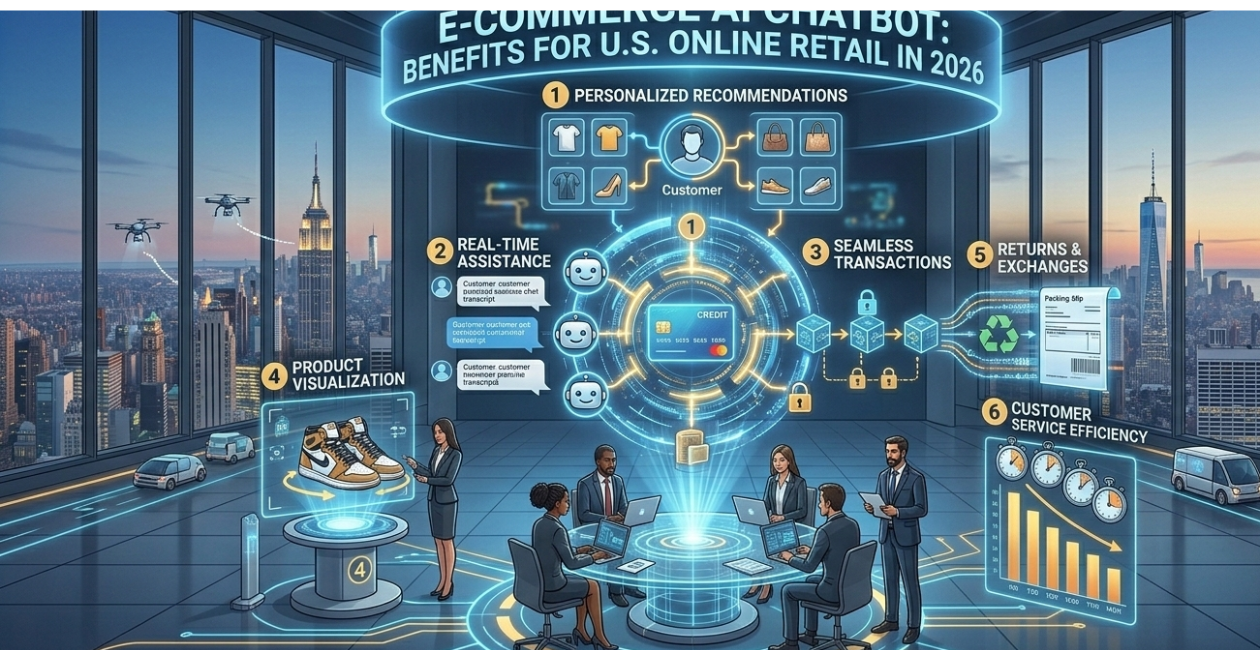
Margins are tighter. Customer expectations are higher. Acquisition costs continue to climb. And the operational load of running a modern e-commerce business has quietly become unsustainable when managed through traditional support models.
The pressure point is not just customer service. It is revenue capture.
Shoppers expect immediate answers. They want product guidance that feels personal. They want tracking updates without friction. They want checkout issues resolved in seconds. When they do not get that, they leave. Not angrily. Just quietly.
In 2026, an AI chatbot for e-commerce in the U.S. is no longer an FAQ widget. They are shopping agents embedded across the entire buyer journey. North America leads global adoption with roughly 42% market share. That is not a technology trend. That is a competitive shift. The question for retail executives is straightforward: are you using conversational AI to reduce cost and increase revenue at the same time, or are you still treating it as a support experiment?
1. 24/7 Instant Support That Protects Revenue
U.S. e-commerce runs 24 hours a day. Your support team does not. When a shopper has a shipping question at 11:45 PM or needs clarification about sizing, they will not wait until morning. They will move to another site. Modern AI chatbots eliminate that gap.
Impact benchmarks from current deployments show:
● First response times reduced by up to 90%
● Conversations handled in under 15 seconds
● Continuous availability 24/7/365
This is not about convenience. It is about lost revenue prevention. Every unanswered question at checkout is a silent conversion leak.
2. Hyper-Personalization That Actually Moves Revenue
Early chatbots were scripted. Today’s AI shopping agents use large language models to analyze browsing history, purchase behavior, and context in real time. The difference is material.
Instead of greeting a user by name, the AI suggests products aligned with:
● Preferred size
● Style history
● Budget range
● Previously viewed categories
This level of contextual selling drives measurable outcomes. Retailers report revenue increases between 15% and 35% from conversational personalization alone. It is not about sounding friendly. It is about guiding the shopper to a decision faster, with higher confidence.
3. Cart Abandonment Recovery
Cart abandonment is not a mystery. It is hesitation. Shipping costs. Return policies. Payment failures. Last-minute doubt.
An AI chatbot solution for e-commerce can detect behavioral signals at checkout and intervene in real time:
● Clarifying delivery timelines
● Explaining return policies
● Offering limited incentives
● Suggesting alternative payment options
Recovery rates between 23% and 29% are being reported in active deployments. The key is timing. Email recovery campaigns are reactive. Conversational recovery is immediate.
4. WISMO Automation and Order Management
“Where Is My Order?” remains the most frequent support inquiry in U.S. retail.
An AI chatbot platform for e-commerce allows you to integrate the agent directly with shipping APIs and order systems to:
● Provide real-time tracking
● Issue status updates
● Initiate returns
● Trigger refunds
● Update delivery addresses when policy allows
Up to 80% of routine inquiries can be resolved instantly without human intervention. The operational impact is significant. Fewer repetitive tickets. Shorter queues. Support teams focused on complex, high-value cases.
5. Cost Efficiency Without Sacrificing Experience
Hiring human support linearly is expensive. Every seasonal spike requires more staff. Every expansion into new time zones increases overhead. AI agents scale exponentially.
One bot can manage thousands of concurrent conversations during peak periods such as Black Friday without increasing payroll.
Industry averages show:
● 30% to 40% reduction in customer service costs
● Lower cost per contact
● No compromise in availability
This is not workforce replacement. It is workload redistribution. High-volume routine queries are automated. Human teams handle exceptions and escalations.
6. Interactive Product Guidance and Virtual Styling
Advanced AI shopping agents now support multimodal interactions. Customers can upload images of products they like. The AI identifies similar items in your inventory.
This mimics the in-store boutique experience:
● Outfit pairing suggestions
● Style matching
● Complementary accessory recommendations
For fashion, home decor, and lifestyle brands, this is a revenue driver. It shortens discovery time and increases basket size.
7. Multilingual and Multichannel Consistency
The U.S. market is linguistically diverse. Expectations for language support are rising. Approximately 74% of consumers prefer multilingual assistance options.
AI chatbots provide a consistent brand voice across:
● Website
● SMS
● Messenger platforms
Spanish, Mandarin, and other major languages can be handled without building separate support teams for each. Consistency matters. Customers should not receive different answers depending on the channel they choose.
8. Higher Average Order Value Through Conversational Upselling
A skilled in-store associate naturally recommends complementary items. AI shopping agents now replicate that behavior digitally.
Examples:
● “Those jeans pair well with this belt.”
● “Customers who bought this laptop also added this protective case.”
● “Would you like to add expedited shipping?”
Retailers report up to 15% higher average order value when cross-sell and upsell are embedded into conversational flows. This is not pushy selling. It is a contextual suggestion when buying intent is already present.
9. Lead Qualification and Actionable Data
Every chatbot interaction generates structured data:
● Purchase intent signals
● Objection patterns
● Drop-off reasons
● Product confusion points
This feeds back into merchandising, pricing, and UX decisions. Lead qualification accuracy improves by roughly 45% when AI asks intent-based questions before routing to sales teams. The insight value is often underestimated. The AI chatbot for lead generation becomes both a sales engine and a research tool.
10. Seamless Human Handoff
Early chatbot deployments frustrated customers by trapping them in rigid flows. Modern AI systems are built differently.
When complexity increases or frustration is detected:
● The AI transfers the full transcript
● Context is preserved
● The human agent continues the conversation without repetition
Organizations report 35% to 40% improvements in customer satisfaction when handoff is handled properly. The goal is not to eliminate human interaction. It is to deploy it where it adds the most value.
Business Impact Comparison
| Metric | Traditional Support | AI-Powered Support (2026) |
| Response Time | Minutes to hours | Under 15 seconds |
| Availability | Limited business hours | 24/7/365 |
| Cost Per Contact | High, labor-driven | Low, SaaS/API driven |
| Scalability | Linear | Exponential |
| Cart Recovery | Post-abandonment email | Real-time intervention |
How AI chatbots increase conversions?
If conversion rate is the clearest measure of commercial performance, then the real question is not whether you deploy an AI assistant. It is how directly it influences buying decisions. An AI chatbot sits at the intersection of intent and friction. That is where conversions are either won or lost.
When shoppers hesitate due to sizing, delivery timelines, or payment concerns, an AI chatbot for an e-commerce website answers instantly within the checkout flow. That prevents drop-off and keeps momentum intact. It also increases website engagement by turning passive browsing into active interaction. Instead of scrolling, customers ask questions, compare options, and receive personalized recommendations based on budget, preferences, and context.
Real-time product suggestions, cross-sells, and checkout assistance directly influence purchase decisions. When hesitation is addressed immediately, confidence rises. In simple terms, AI chatbots increase conversions by reducing uncertainty, shortening decision time, and guiding customers to complete the purchase while they are still ready to buy.
What This Means for Retail Leadership
AI shopping agents now operate across three value layers:
1. Revenue protection
2. Revenue expansion
3. Cost control
Most retailers initially adopt chatbots for cost reduction. The greater opportunity lies in revenue growth.
When implemented strategically, conversational AI influences:
● Conversion rates
● Average order value
● Repeat purchase frequency
● Customer satisfaction
It becomes embedded in merchandising, marketing, and operations.
The competitive risk is clear. If your competitors provide instant, personalized guidance and you provide static FAQ pages, shoppers will notice.
The Strategic Question
AI chatbots in U.S. e-commerce are no longer experimental technology. They are operational infrastructure. The decision is not whether to deploy one. It is how deeply it should integrate into your commercial model. Is it answering basic questions, or is it guiding product discovery, recovering abandoned carts, managing orders, qualifying leads, and feeding data back into strategy?
Retail in 2026 rewards speed, relevance, and responsiveness. E-commerce AI chatbot delivers all three at scale. The leaders who treat them as a revenue engine rather than a support add-on will compound the advantage.